


It’s Thursday afternoon. The shredding bin by the copier has been full since Tuesday, and someone has set a stack of client files on top of it “just for now.” Those files will probably stay there until pickup day, where anyone walking by can see them.
This happens in more offices than you’d think, and the cause is usually the same. The office doesn’t have the right number of office shredding bins. With too few, people start cutting corners. With too many, you pay for space you don’t use.
Whether you run a small office in Mesa or a busy practice in Phoenix, a few simple factors can help you find the right setup. This guide walks through how many bins to plan for, which sizes make sense, where to put them, and how your pickup schedule affects the numbers.
How Many Office Shredding Bins Do You Need?
The right number depends on two things: how many people work in your office and how much paper your industry produces. A five-person software startup and a five-person law firm handle very different amounts of sensitive paper.
Use this table as a general starting point:
| Office Size | Standard Office | Paper Heavy Office |
| Small office (1 to 10 employees) | 1 console | 1 to 2 consoles |
| Medium office (11 to 30 employees) | 2 to 3 consoles or carts | 3 to 5 consoles or carts |
| Large office (30+ employees) | At least 1 per floor or department | At least 1 per department, plus carts in print and records areas |
Not Sure If Your Office Is Paper Heavy?
Your industry gives you a clue. Law firms, medical and dental practices, accounting firms and property management companies usually fall into this group. Your day-to-day work is a better guide, though. Ask yourself:
- Do we handle client, patient or employee records every day?
- Do we regularly print contracts, invoices, statements or reports?
- Do we receive a lot of mail or paper forms with personal information?
- Do we keep paper files for legal, tax or compliance reasons?
- Do we follow privacy rules like HIPAA or the FTC Disposal Rule?
- Do our current bins fill up well before pickup day?
If you answered yes to two or more of these questions, plan your bins like a paper heavy office. When you’re on the fence, it’s safer to start with one extra bin than to deal with overflow later.
Understanding Shredding Bin Sizes
Getting the count right is only half the job. Container size matters just as much, and the right mix depends on where each one will sit. Here’s how the locked shredding containers we provide compare.
Shredding Consoles
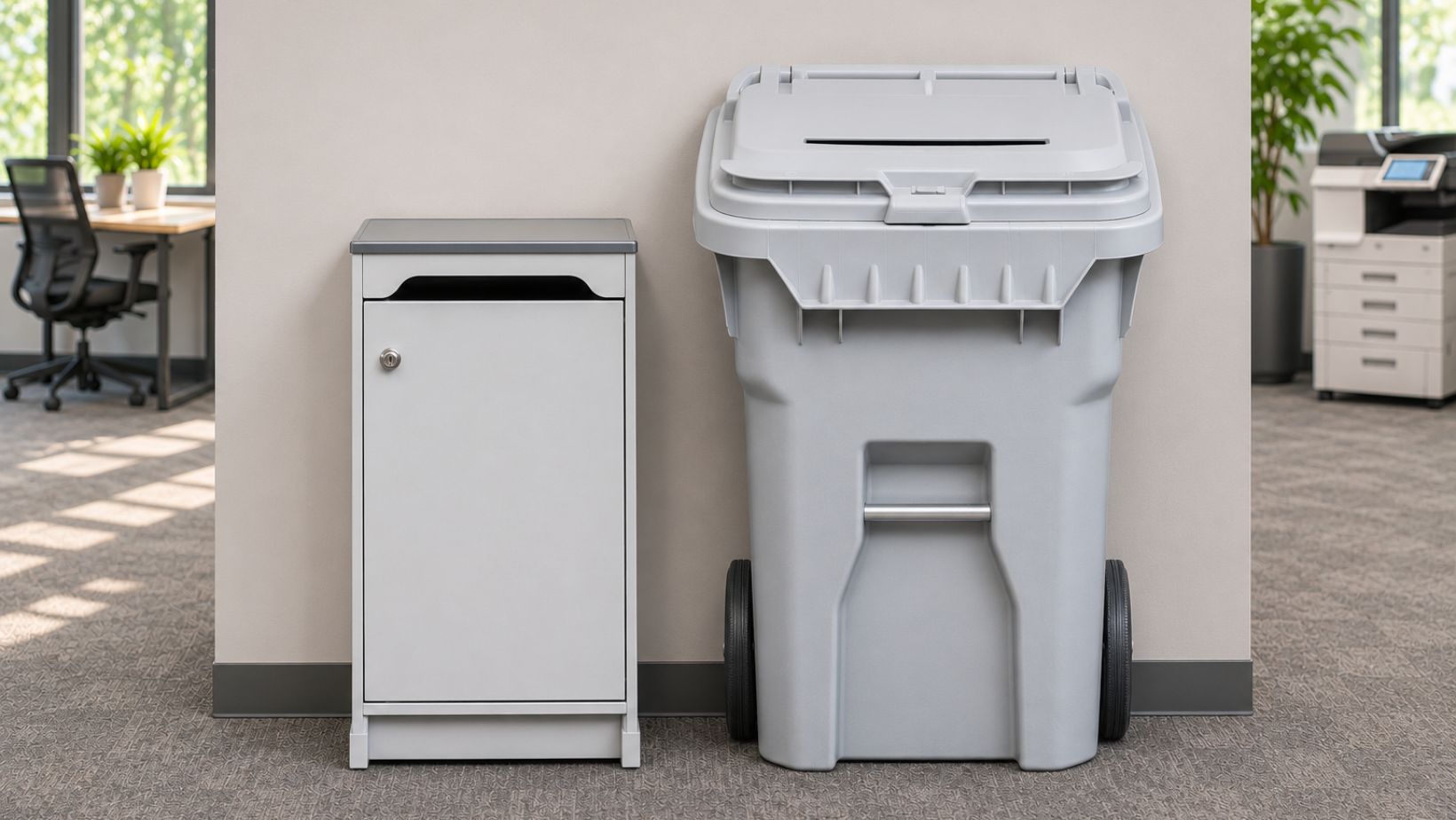
Our office console, the Regal Ergo Cabinet, holds about 90 pounds of paper. At roughly 19 inches wide and 35 inches tall, it fits well in private offices, reception areas and smaller teams. It works like a small piece of office furniture, so you get secure disposal that doesn’t look out of place.
Large Locked Shredding Bins
Rolling carts come in two sizes:
- 65 gallon cart: Holds up to 250 pounds
- 95 gallon cart: Holds up to 375 pounds
These carts are built for high-volume areas like records rooms, copy and print stations, and busy departments such as HR or accounting.
How Much Paper Each Size Holds
To give you a rough idea, a standard file box of paper weighs around 30 pounds:
- Console (90 lb): About 3 file boxes
- 65 gallon cart (250 lb): About 8 file boxes
- 95 gallon cart (375 lb): About 12 file boxes
What Else Affects How Many Shredding Bins Your Office Needs
Team size and paper volume give you a baseline, but a few other factors can push your number up or down.
- Office layout: If your team is spread across several floors or suites, one central bin won’t work. People won’t walk two hallways to throw away a single page.
- A shred everything policy: When your team adopts a shred everything policy and stops deciding page by page, paper volume goes up quickly.
- Busy seasons: Tax season, year-end closeouts, and annual file reviews can double the paper going into your bins for weeks at a time.
- Hybrid schedules: Fewer people in the office doesn’t always mean less paper. Busy in-office days can fill bins faster than you’d expect.
- A growing team: If you’re hiring, plan for where your headcount will be in six months, not just where it is today.
How Scheduled Shredding Changes the Math
Your locked shredding containers come with your scheduled shredding service, and your pickup schedule and bin count work together. Your containers are emptied on a regular cycle, so they’re less likely to fill up between visits.
Take a 20-person office on monthly service that needs three containers to keep up. Move that same office to biweekly pickups, and two containers may be enough. You end up deciding between more bins and more visits. Most businesses find the best balance once they know how often their office actually needs shredding. The goal is containers that are close to full on pickup day, but never overflowing.
Signs You Don’t Have Enough Office Shredding Bins
Your office will usually show you when it’s short on bins. Watch for these signs:
- Bins are overflowing between pickups
- Paper is stacked on top of or next to the bins
- Employees keep “to shred” piles in desk drawers or boxes
- Sensitive documents end up in regular recycling
- Staff skip the bin because it’s too far from their desk
Any one of these creates a security gap, and the last two carry real risk. In Arizona, A.R.S. 44‑7601 prohibits businesses from knowingly discarding paper records that pair a person’s name with details like a Social Security number or financial account number, without first making that information unreadable. Penalties can reach $5,000 for repeat violations.
Where to Put Your Locked Shredding Bins
Even with the right number of bins, poor placement can undo the whole setup. If a bin isn’t where people need it, it won’t get used. Smart placement of locked shredding bins comes down to putting them where sensitive paper is created and handled.
- Next to copiers and printers: Misprints, extra copies, and forgotten print jobs pile up here faster than anywhere else. A rolling cart works well in busy print areas.
- In HR and payroll: Employee files, tax forms and benefits paperwork are some of the most sensitive documents in any office. Keep a container in or right next to these departments.
- In accounting and finance: Invoices, bank statements and check stubs need a secure place to go as soon as they’re no longer needed.
- At the front desk: Reception handles intake forms, visitor logs and mail. A console fits neatly behind the desk without looking out of place.
- In records and file rooms: These areas are ideal for the larger 95 gallon carts, especially during file cleanups.
- In conference rooms: Meeting handouts and printed reports often get left on the table. A console near the door makes it easy to clear them out.
As a rule of thumb, no employee should have to walk more than a short distance to reach a bin. Keep containers in staff areas where they’re easy to see, and keep them out of walkways and exits.
Finding the Right Number of Office Shredding Bins for Your Team
There’s no single number that fits every business. The right setup for your office shredding bins depends on your team size, industry, layout and pickup schedule. Too few bins lead to overflow and shortcuts, and too many mean paying for capacity you never use. When everything fits how your office works, protecting sensitive information becomes part of the daily routine. If your bins are full before pickup day, it’s time to add a container or increase your pickup frequency.
You don’t have to work this out alone. Tell us about your team, your space, and how much paper you handle. We’ll help you choose the right mix of locked shredding containers and a pickup schedule to match, so your bins are emptied before they ever overflow.
Contact us today to set up scheduled shredding for your office, and we’ll build a plan that keeps your sensitive paper secure.
Frequently Asked Questions
Can I mix consoles and rolling carts in the same office?
Yes, and most offices do. Consoles work well in private offices and at reception, and larger carts handle high-volume areas like print stations and records rooms.
Who has the key to a locked shredding bin?
Only trained shredding technicians should have keys. That’s what keeps documents secure from the moment they go into the bin until they’re destroyed.
What kinds of documents should go in a shredding bin?
Anything with personal, financial, client or employee information should go in the bin. That includes invoices, bank statements, HR files, contracts, medical records and old mail with names and account numbers. If you’re unsure whether something is sensitive, it’s safer to shred it.
